How to choose a license for an academic project
Hugo Gruson
Free/Libre Open Source Software (“FLOSS”)
Four freedoms:
- The freedom to run the program as you wish, for any purpose.
- The freedom to study how the program works, and change it so it does your computing as you wish.
- The freedom to redistribute copies so you can help others.
- The freedom to distribute copies of your modified versions to others. By doing this you can give the whole community a chance to benefit from your changes.
.footnote[Source: https://www.gnu.org/philosophy/free-sw.en.html]
Copyleft licenses
You have to keep the same license (or a compatible FLOSS license) for downstream projects.
- GNU Public License (version 2 & 3) and derivatives:
- AGPL (for applications on servers mainly)
- LGPL (for libraries mainly)
- Creative Commons ShareAlike (“CC-SA”)
Copyleft licenses
GNU Public License notable examples
Creative Commons ShareAlike notable examples
Non-copyleft licenses
- MIT
- Apache
- BSD
- CC0 / zero-clause BSD / public domain
Non-copyleft licenses
MIT notable examples
BSD(-like) notable examples
numpy, pandas, scipy, pytorch
Apache notable examples
Other notable cases
Intermediary copyleft:
- MPL: only redistribute parts under copyleft, not the whole codebase.
Relicensing clause:
- Artistic 2.0: the copyleft project can adopt another copyleft license.
Non-free licenses:
- Creative Commons NoDerivative / NoCommercial (CC-ND / CC-NC)
- JSON license
The Software shall be used for Good, not Evil.
A resource to help you choose
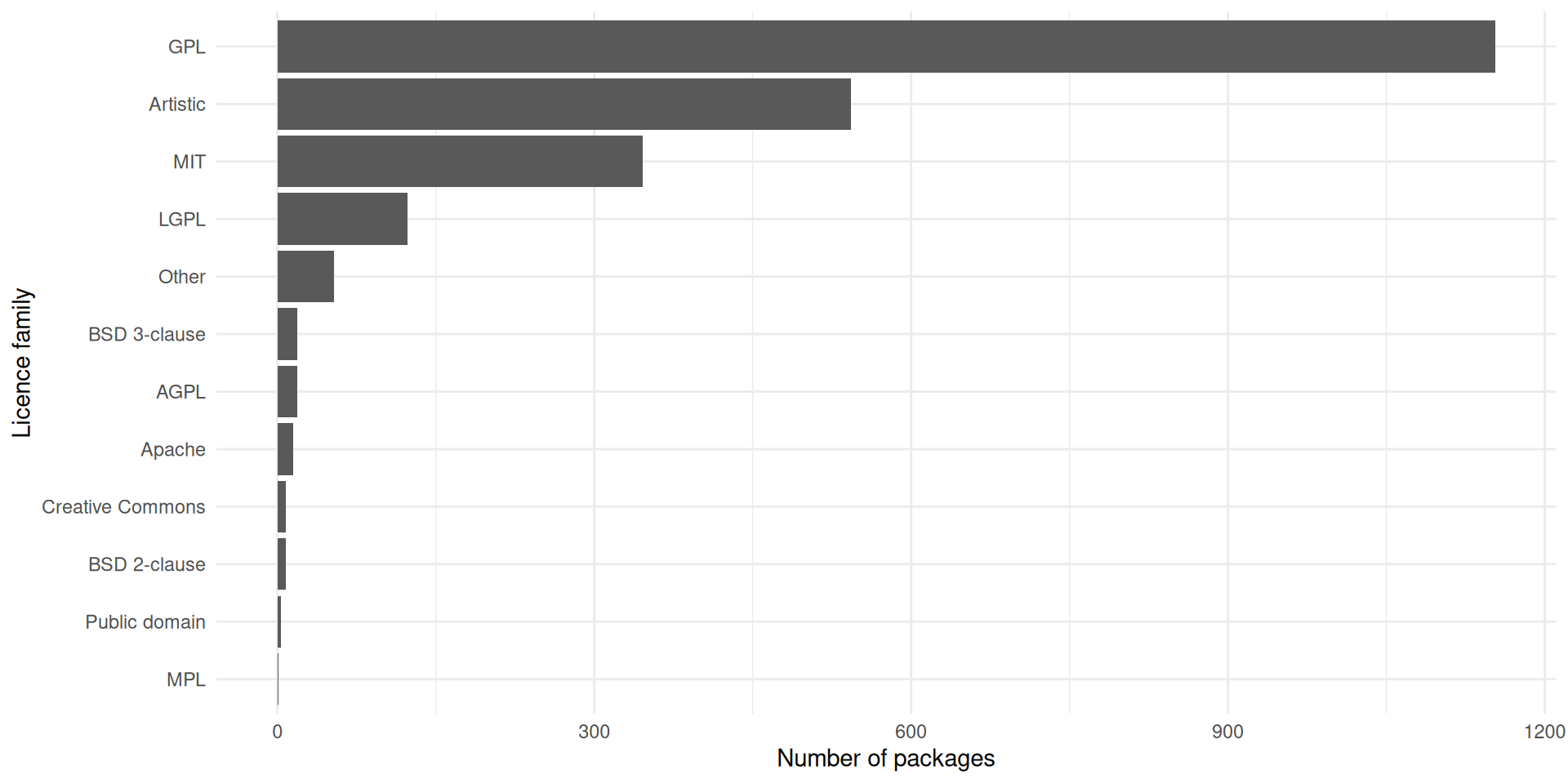
Licenses in CRAN
As of 2026-10-01:
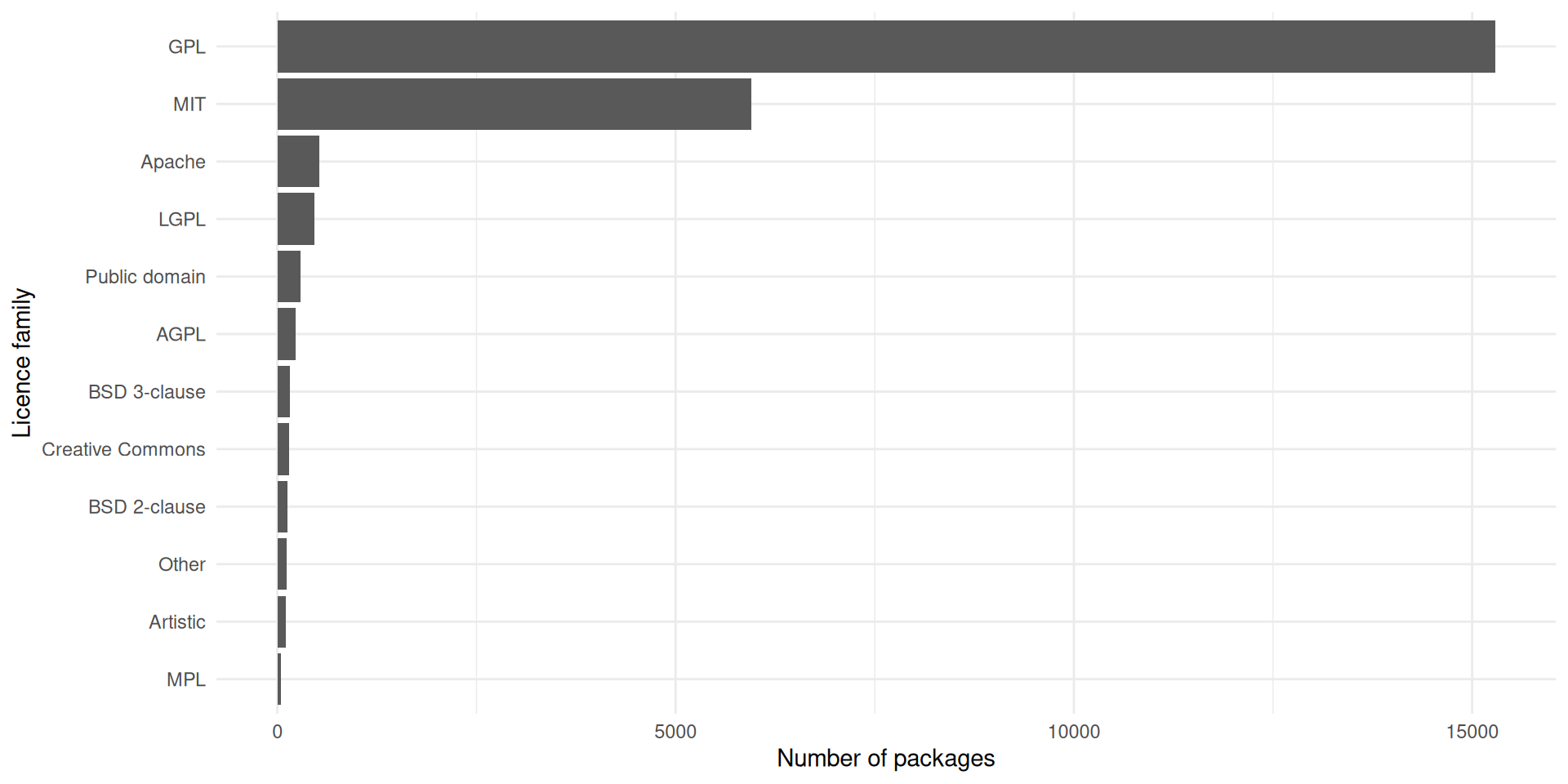
Licenses in Bioconductor
As of 2026-10-01: