library(tidyverse)Some data on Spatial Biology support in Bioconductor
R
interoperability
spatial biology
Bioconductor
Hugo Gruson 
Bioconductor since its inception has played an important role in the analysis of molecular biology data (microarrays, bulk sequencing, single cell sequencing, etc.). In the recent years, spatial biology has been growing tremendously and there is a proportional demand for new packages to deal with this new data class.
While there are clear data points showing that this support is being added to Bioconductor, such as the publication of the OSTA book, I was curious to look at quantitative larger scale data on more indicators. This blog post will collect and plot data about the ‘Spatial’ biocView in an easily digested format, but will not try to guide the reader in the interpretation of these numbers.
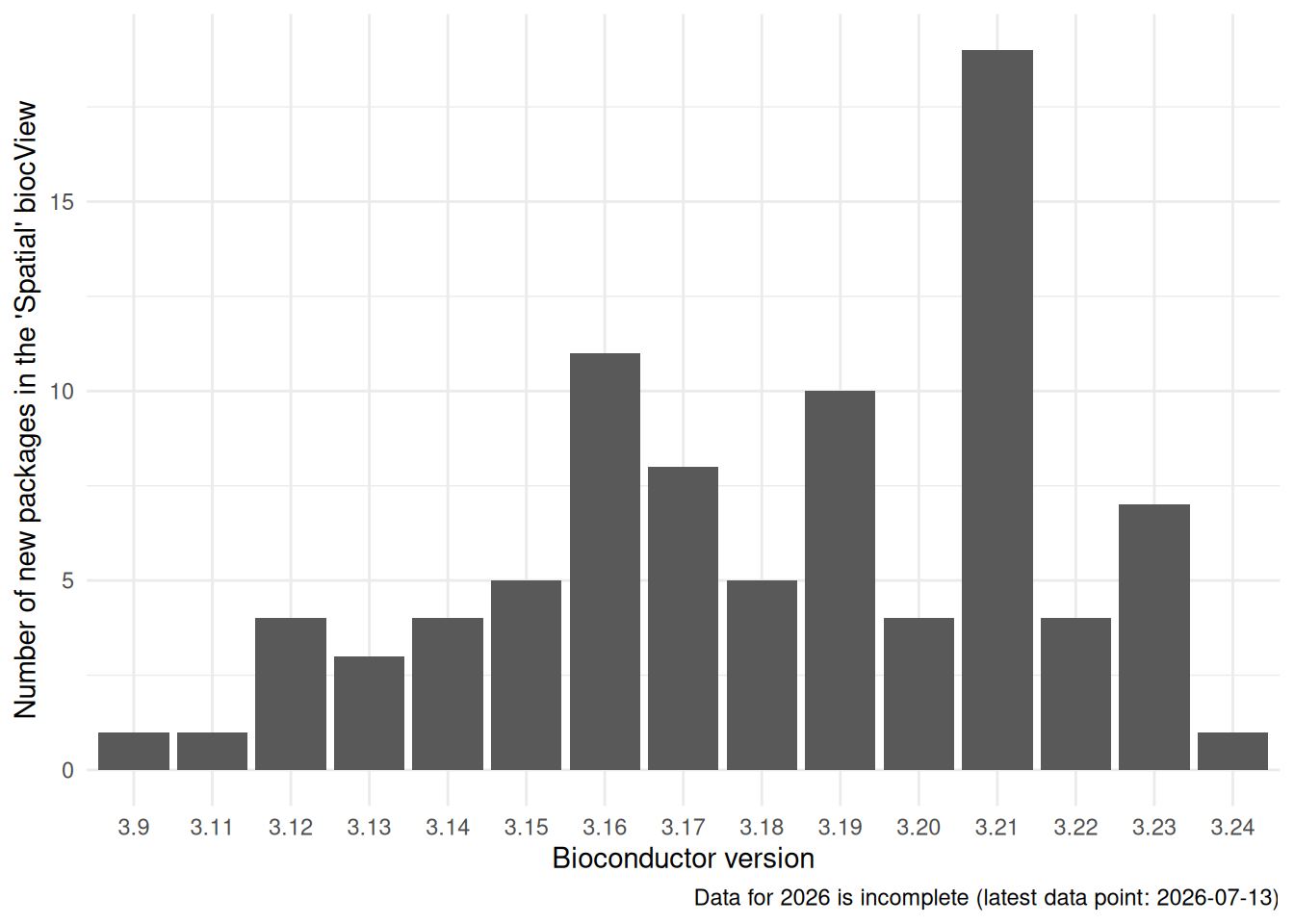
Number of packages in the ‘Spatial’ biocView
spatial_bioc_pkgs <- jsonlite::fromJSON("https://bioc.r-universe.dev/api/packages") |>
  filter(map_lgl(`_topics`, ~ "spatial" %in% .x))
spatial_bioc_pkgs <- spatial_bioc_pkgs |>
pull(Package) |>
BiocPkgTools::getPkgYearsInBioc() |>
left_join(spatial_bioc_pkgs, by = c("package" = "Package")) |>
mutate(first_version_available = as.factor(package_version(first_version_available)))spatial_bioc_pkgs |>
count(first_version_available) |>
arrange(first_version_available) |>
ggplot(aes(x = first_version_available, y = n)) +
geom_col() +
theme_minimal() +
labs(
x = "Bioconductor version",
y = "Number of new packages in the 'Spatial' biocView",
caption = "Data for 2026 is incomplete (latest data point: 2026-07-13)"
)
Total number of downloads for packages in the ‘Spatial’ biocView
spatial_bioc_pkgs |>
  pull(package) |>
  map(function(pkg) {
    BiocPkgTools::pkgDownloadStats(pkg, years = 2019:2026) |>
      mutate(Package = pkg)
  }) |>
  bind_rows() |>
  group_by(Package, Year) |>
  summarise(Nb_of_downloads = sum(Nb_of_downloads), .groups = "drop") |>
  mutate(
    Package = fct_reorder(Package, Nb_of_downloads),
    Package = fct_lump_n(Package, n = 10, other_level = "Other")
  ) |>
  ggplot(aes(x = Year, y = Nb_of_downloads, fill = Package)) +
    geom_col() +
    theme_minimal() +
    labs(
      x = "Year",
      y = "Number of downloads / year for packages in the 'Spatial' biocView",
      caption = "Data for 2026 is incomplete (latest data point: 2026-07-13)"
    ) +
    theme(legend.position = "none")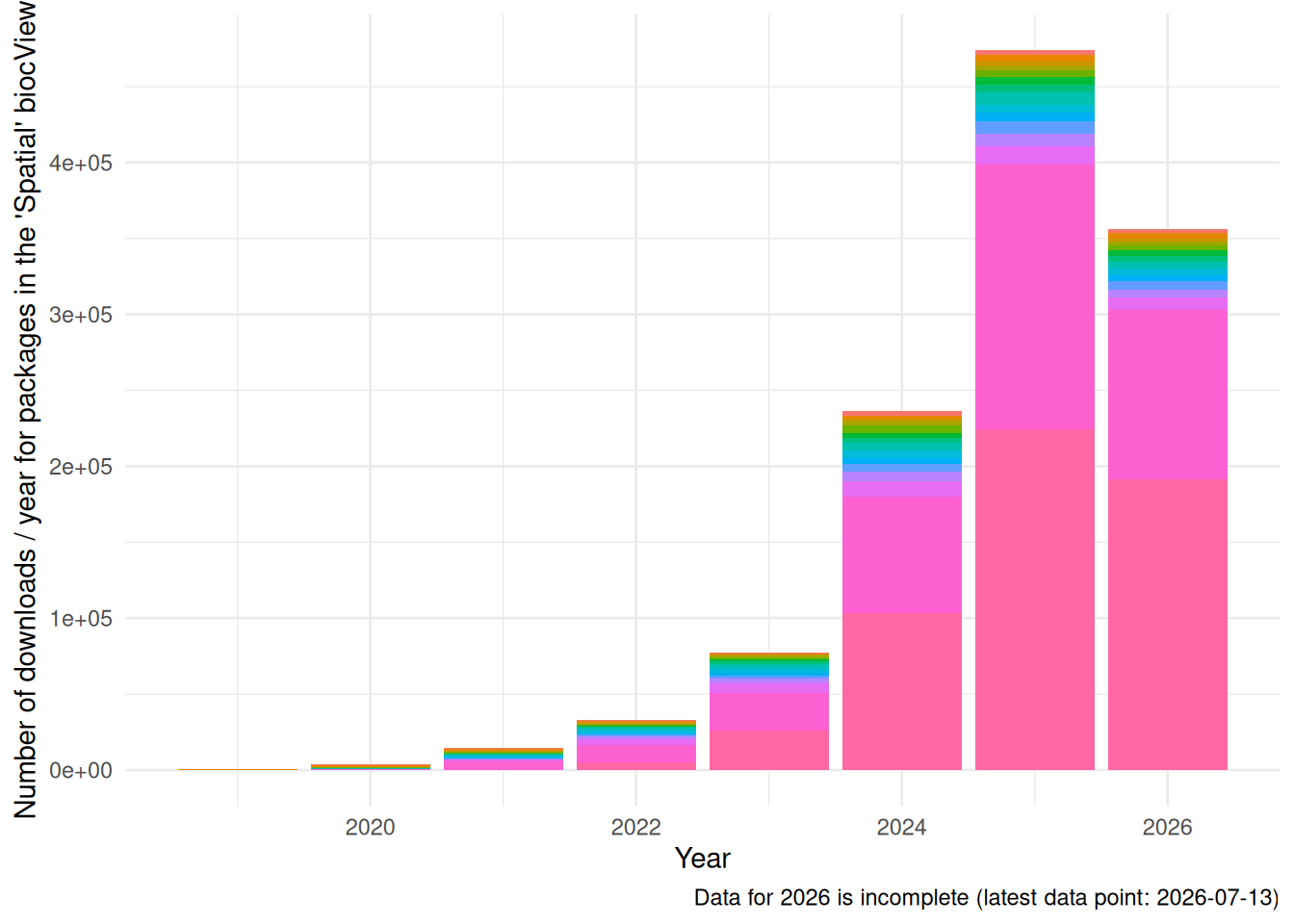
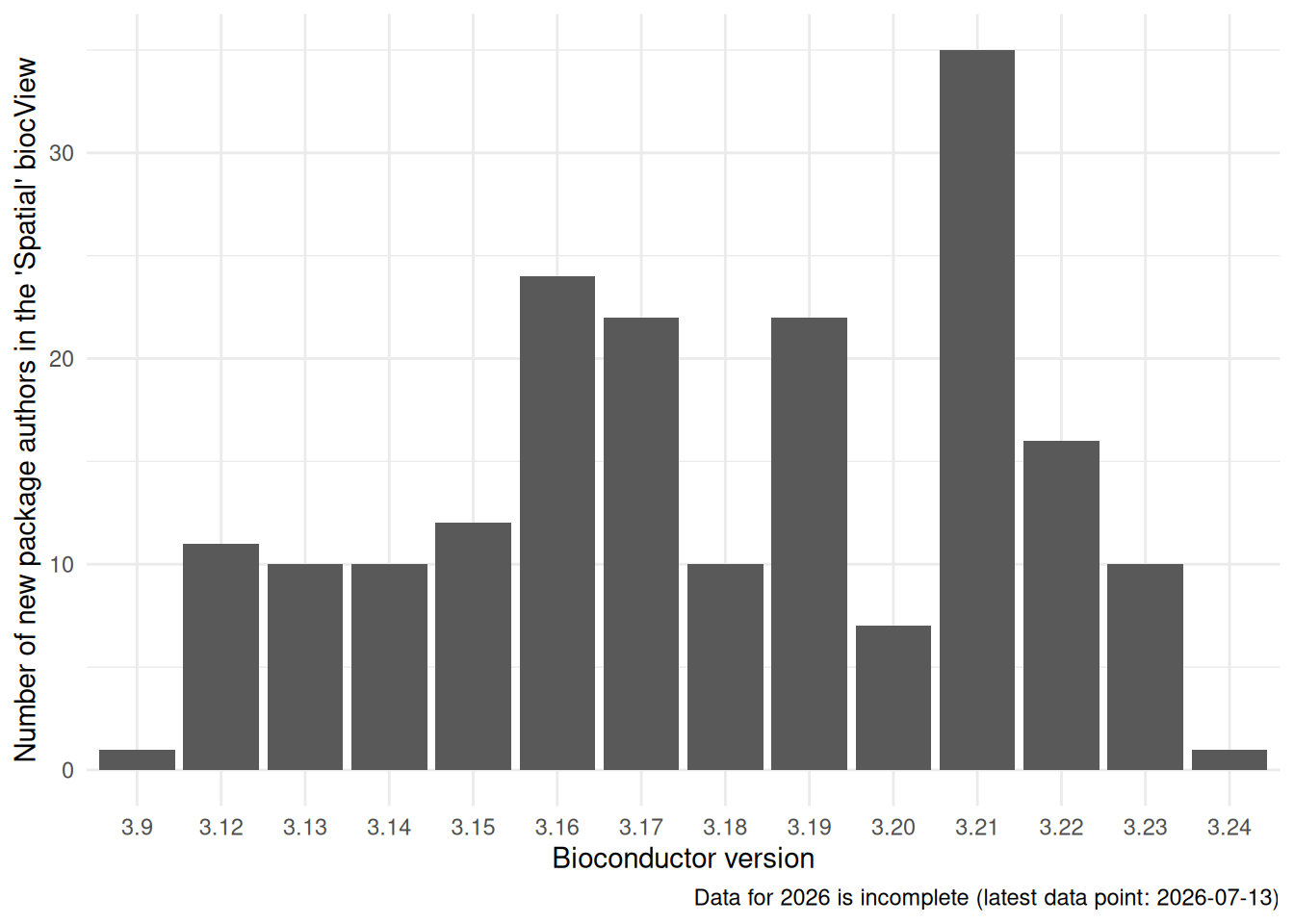
Number of package authors in the ‘Spatial’ biocView
Because there can be variations in how author names are reported, we will use the authoritative package to deduplicate names.
library(authoritative)
spatial_bioc_pkgs |>
  mutate(Authors = map(`Authors@R`, parse_authors_r)) |>
  mutate(Authors = map(Authors, function(x) format(x, include = c("given", "family")))) |>
  unnest_longer(Authors) |>
  mutate(Authors = invert_names(Authors, Authors)) |>
  mutate(Authors = expand_names(Authors, Authors)) |>
  filter(!duplicated(Authors)) |>
  group_by(first_version_available) |>
  summarise(n = n_distinct(Authors), .groups = "drop") |>
  ggplot(aes(x = first_version_available, y = n)) +
    geom_col() +
    theme_minimal() +
    labs(
      x = "Bioconductor version",
      y = "Number of new package authors in the 'Spatial' biocView",
      caption = "Data for 2026 is incomplete (latest data point: 2026-07-13)"
    )
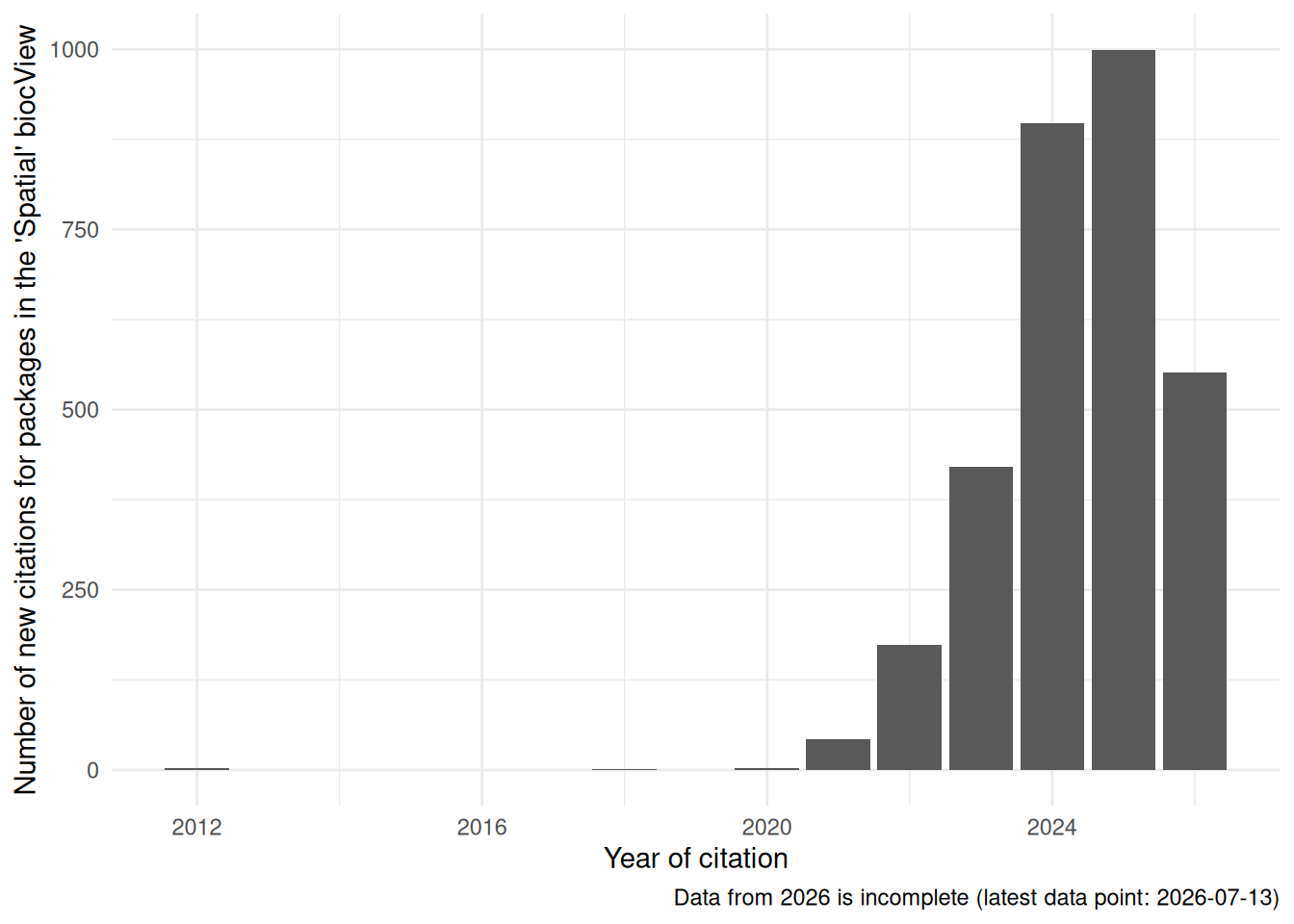
Citations over time in the ‘Spatial’ biocView
get_doi <- function(pkg) {
  citation_file <- withr::local_tempfile()
  url <- tryCatch(
    gh::gh("/repos/{owner}/{repo}/contents/{path}", owner = "bioc", repo = pkg, path = "inst/CITATION") |>
      pluck("download_url"),
    error = function(e) NULL
  )
  if (is.null(url)) {
    return(NULL)
  }
  download.file(url, citation_file, quiet = TRUE)
  citation <- tools:::.parse_CITATION_file(citation_file, encoding = "UTF-8")
  lapply(citation, function(x) {
    x$doi
  }) %||% glue::glue("10.18129/B9.bioc.{pkg}")
}
spatial_bioc_pkgs <- spatial_bioc_pkgs |>
mutate(dois = map(package, get_doi) ) |>
unnest_longer(dois)citations <- spatial_bioc_pkgs |>
pull(dois) |>
unique() |>
openalexR::oa_fetch(doi = _, entity = "works")citations |>
filter(cited_by_count > 0) |>
pull(counts_by_year) |>
bind_rows() |>
group_by(year) |>
summarise(cited_by_count = sum(cited_by_count), .groups = "drop") |>
ggplot(aes(x = year, y = cited_by_count)) +
geom_col() +
theme_minimal() +
labs(
x = "Year of citation",
y = "Number of new citations for packages in the 'Spatial' biocView",
caption = "Data from 2026 is incomplete (latest data point: 2026-07-13)"
)
Limitations
- Some packages may relate to Spatial Biology but not be in the ‘Spatial’ biocView, since biocView classification is based on self-reporting by package authors.
- Some packages related to Spatial Biology are on CRAN (e.g.,
SVG).
Future directions
I may be biased but I think more very exciting things are on the horizon. In particular, in Bioconductor 3.24, which will be released in October 2026, there will be a new spatialdataR package, which offers interoperability with the spatialdata Python package, and the scverse ecosystem, as well as lazy operations on very large spatial datasets.